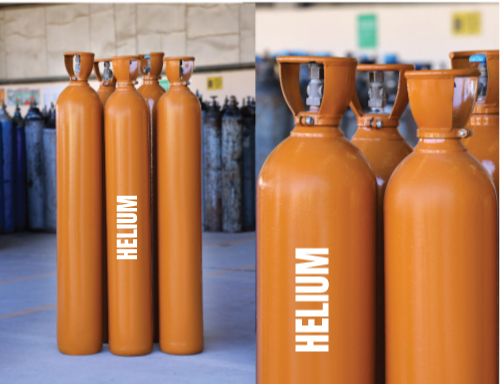
Helium (He)
Industrial Grade
Helium gas (He) has several unique properties, such as being lighter than air, non-reactive, and the only element that remains a gas at extremely low temperatures. These characteristics make it invaluable in various fields. Here are some of the most important applications of helium:
Helium Applications:
1. Cryogenics and Cooling:- Cooling Superconducting Magnets: Helium is widely used in cooling superconducting magnets, especially in magnetic resonance imaging (MRI) machines, particle accelerators, and fusion reactors. Helium's low boiling point of -268.93°C (4.22 K) makes it ideal for maintaining the extremely low temperatures required for superconductivity.
- Cryogenic Research: Helium is used in scientific research and experimental setups that require extremely low temperatures. It is used to cool cryostats, which are devices that maintain low temperatures for experiments in physics and material science.
- MRI Scanners: Helium is critical for maintaining the low temperatures needed by MRI (Magnetic Resonance Imaging) machines, which rely on superconducting magnets to generate strong magnetic fields.
- Respiratory Treatments: Helium is sometimes mixed with oxygen (helium-oxygen mixtures) for patients with respiratory disorders like COPD or asthma. Because helium is less dense than air, it allows for easier breathing by reducing the work needed to move air in and out of the lungs.
- Rocket Propulsion: Helium is used in the aerospace industry to pressurize rocket fuel tanks and to control the flow of liquid fuel during space missions. Its non-reactive nature ensures safety during high-pressure and high-temperature environments.
- Balloon and Airship Lifting Gas: Helium is used to fill weather balloons, observation balloons, and airships (like blimps) because it is lighter than air and non-flammable, unlike hydrogen which is highly flammable.
- Shielding Gas for Welding: Helium is used as a shielding gas in arc welding, especially for materials like aluminum, titanium, and stainless steel. It provides a stable arc, higher heat, and improves the quality of the weld.
- Heat Treatment of Metals: In metal manufacturing, helium can be used in heat-treating processes to provide an inert atmosphere, preventing oxidation and other contaminants during treatment.
- Particle Accelerators: Helium is used in particle accelerators to cool magnets and components to low temperatures, allowing the accelerator to function properly.
- Quantum Computing: Helium is used in experiments related to quantum computing, where its low temperature is necessary to maintain the delicate quantum states of qubits.
- Helium Leak Detection: Helium is used as a tracer gas for detecting leaks in vacuum systems, pipelines, and other critical systems. Its small atomic size and inertness make it ideal for finding even tiny leaks in high-tech equipment, such as vacuum chambers and spacecraft.
- Inert Gas for Processing: Helium is used in semiconductor manufacturing to create an inert atmosphere in processes like chemical vapor deposition (CVD) and other types of material processing. It helps prevent oxidation and other unwanted reactions.
- Cooling in Semiconductor Equipment: Helium is used in semiconductor production and related equipment to cool delicate components during high-precision fabrication.
- Balloons and Airships: Helium is often used in party balloons, weather balloons, and airships as a lifting gas because it is non-flammable and safe, unlike hydrogen, which is highly flammable.
- Search and Rescue Operations: Large balloons filled with helium can be used for search and rescue operations, providing a high vantage point for locating missing persons or objects.
- Tracer Gas in Geological Studies: Helium is used in geological surveys and hydrology to study the flow of underground water, gas reservoirs, and to track movements within Earth's crust.
- Helium Isotope Analysis: The analysis of helium isotopes (particularly helium-3) is used to study geological formations, plate tectonics, and even the age of rocks, providing valuable data for scientific exploration.
- Helium-Oxygen Mixtures for Deep-Sea Diving: In deep-sea diving, a mixture of helium and oxygen (heliox) is used to reduce the risks of nitrogen narcosis and oxygen toxicity. Helium helps prevent the buildup of nitrogen in the body at high depths, improving safety for deep-sea divers.
- Packaging and Pressurization: Helium is used in certain packaging applications, particularly for inflating food packages or as a pressurizing gas in production lines that require an inert atmosphere to prevent contamination or spoilage.
- Hard Drive Technology: Helium is sometimes used in hard disk drives (HDDs) to replace air, allowing for quieter operation and improved performance by reducing friction and heat buildup.
Helium is an essential element across these industries, with its unique properties of low density, inertness, and low boiling point making it indispensable in modern technology, medicine, aerospace, and many other sectors.
CAS No : 7440-59-7
UN No: 1963
EINECS No : 231-168-5
Molecular weight : 4.0026
Appearance : Colorless and odorless
Melting point : -272.2℃
Boiling point : -268.60 ℃
Density : 0.1786kg/cm3
DOT Class : 2.2
99.999% He, High Purity Grade
99.99999% He, Ultra High Purity Grade
| Specification | 99.999% |
|---|---|
| Nitrogen | ≤ 2.0 ppm |
| Oxygen + Argon | ≤ 1.0 ppm |
| Hydrogen | ≤ 1.0 ppm |
| Carbon Monoxide | ≤ 0.5 ppm |
| Carbon Dioxide | ≤ 0.5 ppm |
| Neon | ≤ 1.0 ppm |
| Methane | ≤ 0.5 ppm |
| Moisture | ≤ 0.5 ppm |
| Specification | 99.99999% |
|---|---|
| Nitrogen | ≤ 0.5 ppm |
| Oxygen + Argon | ≤ 0.2 ppm |
| Carbon Monoxide | ≤ 0.1 ppm |
| Carbon Dioxide | ≤ 0.1 ppm |
| Methane | ≤ 0.1 ppm |
| Moisture | ≤ 0.2 ppm |
| Cylinder Specifications | Contents | Pressure | |||
|---|---|---|---|---|---|
| Cylinder Capacity | Valve | Volume | bar | psig | |
| 40L | CGA580 | 6 m³ | 150 | 2175 | |
| 47L | CGA580 | 7 m³ | 150 | 2175 | |
| 50L | CGA580 | 10 m³ | 200 | 2900 | |


