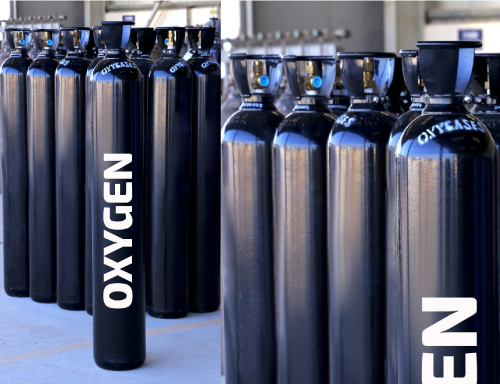
Oxygen(O₂)
Industrial oxygen is a high-purity form of oxygen used extensively in various industrial processes. It is produced using methods like air separation (cryogenic distillation, pressure swing adsorption, or membrane technologies). This oxygen is typically supplied in compressed gas cylinders, liquid tanks, or via pipelines, depending on the scale and nature of the application.
CAS No : 7782-44-7
UN No: 1072
EINECS No : 231-956-9
Molecular weight : 32
Appearance : Colourless, Odourless
Melting point : -218.4 ℃
Boiling point : -183 ℃
Density : 1.429g/L
DOT Class : 2.2 & 5.1
| Cylinder Specifications | Contents | Pressure | ||
|---|---|---|---|---|
| Cylinder Capacity | Valve | Volume | bar | psig |
| 40L | QF-2 | 7 m³ | 150 | 2175 |
| 47L | QF-2 | 7 m³ | 150 | 2175 |
| 50L | QF-2 | 10 m³ | 200 | 2900 |
Applications of Industrial Oxygen
1. Steel and Metal Production
Role: Oxygen is used in blast furnaces to improve combustion, raise temperatures, and reduce impurities in molten metal.
Examples:
Basic Oxygen Steelmaking (BOS) process.
Decarburization of stainless steel and ferrous alloys.
2. Welding, Cutting, and Brazing
Role:
Oxygen supports higher combustion temperatures in conjunction with fuel gases (like acetylene, propane, or hydrogen), making it essential for precise cutting and joining of metals.
Examples:
Oxy-fuel welding.
Flame cutting for dismantling structures or processing metals.
3. Chemical and Petrochemical Industry
Role:
Industrial oxygen is used as a feedstock for synthesizing chemicals and in oxidation reactions.
Examples:
Production of chemicals like ethylene oxide and propylene oxide.
Sulfur recovery in refineries.
Gasification of coal or hydrocarbons for syngas production.
4. Glass and Ceramics Manufacturing
Role:
Oxygen-enriched combustion improves energy efficiency, reduces emissions, and ensures better temperature control.
Examples:
Production of flat glass for automotive and construction industries.
Melting processes in ceramic manufacturing.
5. Pulp and Paper Industry
Role:
Oxygen is employed in processes such as bleaching and delignification.
Examples:
Oxygen delignification to reduce chlorine use.
Effluent treatment for cleaner discharge.
6. Wastewater Treatment
Role:
Oxygen is injected to enhance the aerobic biological treatment of wastewater, increasing the efficiency of the process.
Examples:
Aeration in sewage treatment plants.
Removal of organic contaminants in industrial effluents.
7. Medical and Environmental Applications
Though primarily a high-purity oxygen use case, industrial oxygen plays a role in emergency situations and oxygen enrichment in controlled environments.
Examples:
Use in disaster management for fire suppression or toxic gas neutralization.
Oxygen enrichment in habitats or aquaculture to boost oxygen levels.
8. Energy Production
Role:
Oxygen is critical in processes like oxy-fuel combustion and coal gasification for power generation.
Examples:
Cleaner-burning power plants with reduced greenhouse gas emissions.
Bioenergy production.
9. Aerospace and Space Exploration
Role:
Oxygen is vital in propellants for rockets and to maintain breathable environments in space vehicles.
Examples:
Combustion of liquid fuels in rocket engines.
Support systems for astronauts.
10. Mining and Mineral Processing
Role:
Oxygen is used to enhance reactions during ore refining and recovery of precious metals.
Examples:
Gold cyanidation process.
Smelting and roasting of ores.
Industrial oxygen's diverse applications make it indispensable for modern industry, contributing to improved efficiency, reduced emissions, and better product quality.


